
The Free Calculator, Rebuilt — and the 4% Rule Backtested Against Every Year Since 1928
The no-signup calculator now runs a full Monte Carlo in your browser, and a companion tool backtests the 4% rule against 88 real historical start years.

Before RetireOdds had accounts or a Profile page or any of it, it had a rough calculator we built for ourselves, mostly so we could stop emailing spreadsheets back and forth. We always meant to bring it up to the standard of the real app and always found a reason not to. What finally forced the issue was a friend asking to "just try the numbers" without signing up for anything — a completely reasonable request the old calculator could not really honor, because it was doing a much thinner version of the math underneath.
The same engine, running in your browser
The free calculator now runs a live Monte Carlo simulation entirely client-side — the simulation happens in your browser, with no account and no signup, and nothing is sent anywhere unless you choose to create a share link (which stores just that scenario so the link can reproduce it). It returns the same verdict tiers the full app uses, so a quick check on someone else's laptop and a real plan in your own account are not speaking two different languages. Alongside the verdict there is a safe-spend estimate, the monthly spend that keeps success at your target, Social Security handling, and a view built for expats.
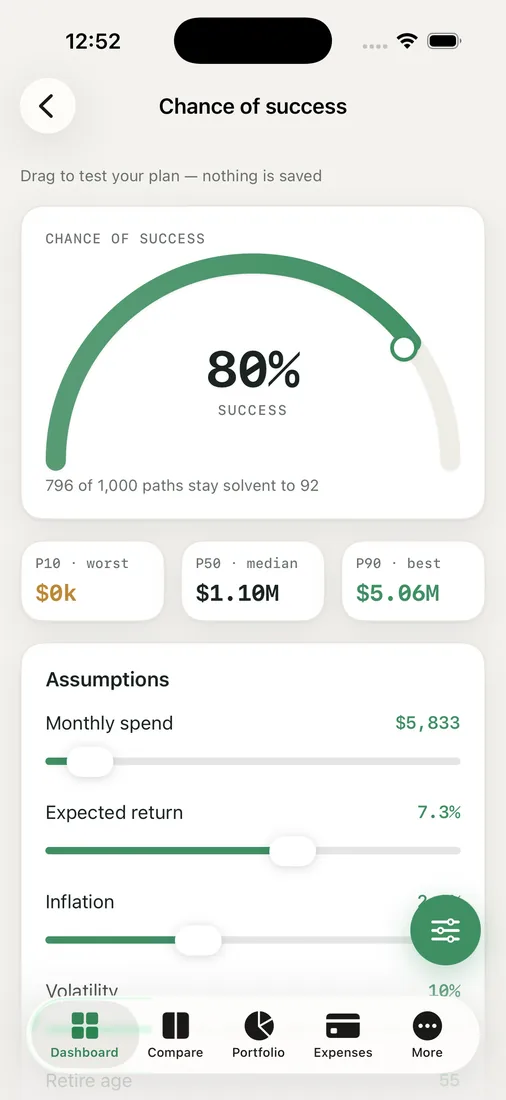
That last part matters more than it sounds. We built RetireOdds while living across borders, and a calculator that only understands one country's Social Security rules is a calculator that quietly stops applying to you the moment you move. The expat view exists because we needed it, not because it looked good on a feature list.
Results can be turned into a short link that reproduces the exact scenario, which turns out to be the actual point of a free, no-signup tool: you can hand someone a number without handing them your data, and they can hand it back with their own tweak.
What backtesting actually answers
The companion piece is the /scenarios pages, and they answer a different question than the calculator does. Instead of simulating a thousand possible futures, they take the classic 4% withdrawal rule and run it against every retirement start year since 1928 — 88 real years of actual US market history, using the same historical dataset the app's backtesting engine draws on elsewhere.

The result is not an average. It is a year-by-year account of which decades broke the rule and which ones were generous by accident, and that distinction is the whole reason to look at history instead of a single blended statistic. An average return smooths over 1929 and 1966 and 2000 as if they were interchangeable. They were not, and if your retirement happens to start in a bad one, the average was never going to tell you.
Same math, checked
Neither of these is a toy version of the real thing. The calculator's math is pinned by parity tests against the app's engine — same code, same answers, whether you are logged in or not — so a quick free check and a full plan agree because they are, underneath, the same calculation.
Key takeaways
- The free calculator runs a real Monte Carlo client-side, with no account and no signup; only an optional share link stores a scenario.
- It returns the same verdict tiers, a safe-spend estimate, Social Security handling, and an expat view — and results share as a reproducible short link.
- The /scenarios pages backtest the 4% rule against all 88 US retirement start years since 1928, showing which eras actually broke it.
- Parity tests pin the calculator's math to the same engine the full app uses.
Try the free calculator with no signup, then see how the 4% rule actually held up against every year since 1928.


