
How Much Cash Should You Hold in Retirement?
A cash buffer lets you avoid selling into a downturn — but too much is a drag. Finding the right size.

We spend in euros now, hold a lot in dollars, and have bills landing in three or four currencies in any given month. So the question "how much cash should we keep" has never been simple for us. Keep too little and a bad market forces us to sell investments at the worst possible moment to cover the rent. Keep too much and we are dragging a giant pile of low-returning money through a retirement that has to last decades. Somewhere between those two mistakes is a right answer, and finding it took actual modeling rather than a rule of thumb.
What a cash buffer is actually for
A cash buffer is a reserve of safe, liquid money, cash and near-cash, that you can spend from without touching your investments. Its job is not to earn returns. Its job is to give you a choice during a downturn.
Recall sequence-of-returns risk: the real danger to a retiree is being forced to sell shares while they are down to fund spending. Those sold shares are gone for good and cannot recover. A cash buffer breaks that chain. When the market drops, you spend from cash for a while and let your investments recover instead of liquidating them at the bottom.
That is the entire value proposition. The buffer buys you time and the freedom not to sell at the worst moment. People often describe it as one to three years of spending held in cash, so that a typical downturn can pass before you would have to touch the portfolio.
The cost of holding too much
Here is the tension, and it is real. Cash is a drag. Over a long retirement, money parked in cash tends to lose ground to inflation and badly trails what a diversified portfolio would have earned. A buffer that is too large quietly costs you growth every single year, and over thirty or forty years that compounds into a serious amount of lost spending power.
So the buffer is genuinely a trade-off, not a free safety blanket.
- Too small, and you can be forced to sell into a crash, the exact harm the buffer exists to prevent.
- Too large, and you sacrifice long-run growth to inflation, weakening the plan from the other direction.
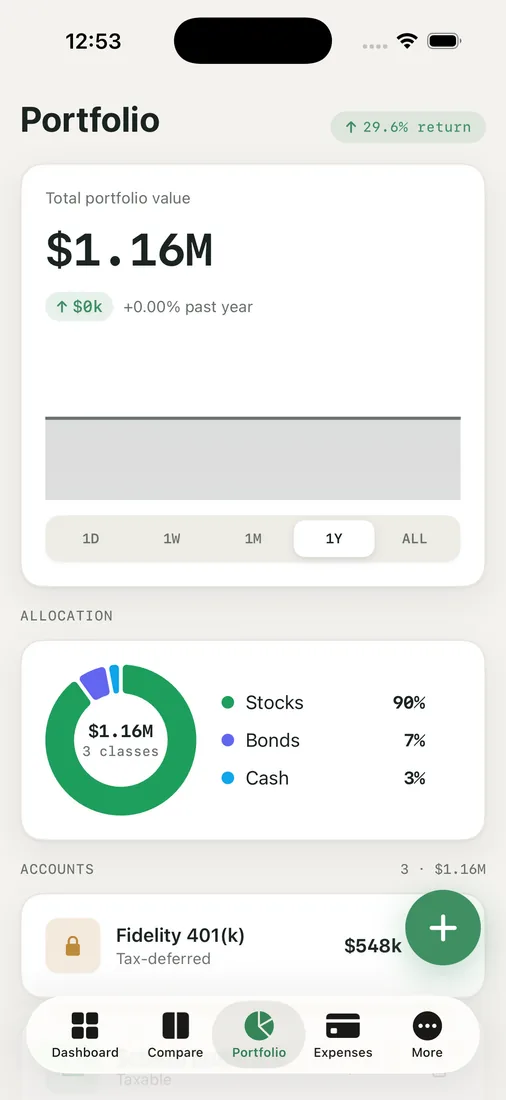
This is where the portfolio view in RetireOdds helps us reason instead of guess. We can size a cash buffer alongside our allocation donut and see the whole picture together. Then, because buffer size interacts with everything else, we test it against the chance view, running the plan with a one-year buffer versus two versus three and watching what happens to the success percentage and the bad-case bands.
Finding our own number
What we look for is the point of diminishing returns. Going from no buffer to a couple of years of spending usually improves the worst-case outcomes noticeably, because it directly defends against the forced-selling problem. Going from two years to five often barely moves the success number while clearly dragging on growth. That flattening is the signal: past a certain size, more cash stops buying safety and just starts costing returns.

For our cross-currency life, there is an extra layer. We want buffer in the currencies we actually spend, so a market drop and an exchange-rate swing do not gang up on us at once. A US-only calculator could never reason about that, which is part of why we built our own. We are not going to hand you a magic number of months, because yours depends on your spending flexibility, your other income, and your nerves. The honest method is to test a few buffer sizes against your own plan and find where the safety stops improving.
We are not advising a specific amount, and the right size shifts with your situation. The takeaway is the framing: treat cash as insurance against forced selling, size it to the risk, and let the trade-off, not a rule of thumb, decide.
Key takeaways
- A cash buffer's real purpose is to let you avoid selling investments into a downturn, which is the core mechanism of sequence-of-returns harm.
- Too little cash exposes you to forced selling; too much drags on long-run growth and loses to inflation over decades.
- The sweet spot is usually where adding more cash stops meaningfully improving your worst-case outcomes, often a couple of years of spending.
- For multi-currency lives, holding buffer in the currencies you actually spend adds another layer of protection.
If you are wondering how much cash to keep, it is worth testing a few buffer sizes against your own plan. Run your own odds and find where more cash stops buying you safety.


