
Test the Sale Before You Make It
RetireOdds now reads your tax lots and prices a trade against brackets, ACA, and IRMAA before you make it, not after.

Last fall I sold a chunk of an old employer stock plan to fund a kitchen renovation, feeling pretty good about the math, and then found out in April that the sale had also nudged our income across a line we did not know existed, one that shaved a few hundred dollars off a healthcare subsidy we were counting on. Nobody warns you about that at the moment you click sell. The gain shows up on the 1099, the subsidy hit shows up on the tax return, and by then the trade is long done. Mayur's response was to ask why the software could not have just told us before we hit the button. So we built the part that does.
Lots, not just balances
The foundation is boring on purpose: every holding can now carry tax lots — share count, cost basis, acquisition date, and where the data came from — instead of one blended balance per account. A readiness score shows how complete that lot data actually is, because a recommendation built on guessed-at cost basis is worse than no recommendation at all.
What the Portfolio page now tells you
With lots in place, Portfolio Insights reads the current tax year against your actual holdings and surfaces a handful of specific things: how much room is left in your current ordinary-income bracket, how much long-term gain you can realize before the capital-gains rate steps up, how close you are to the ACA subsidy cliff if you're on an ACA plan, and how much room remains to the next IRMAA tier if Medicare is in the picture. It also flags tax-loss-harvest candidates — always with the wash-sale caveat attached, because RetireOdds cannot see your transactions across every brokerage you use, only what you've entered here. Oversized single positions get a concentration warning, and a cash-buffer check compares what you're holding against what you've planned to spend.
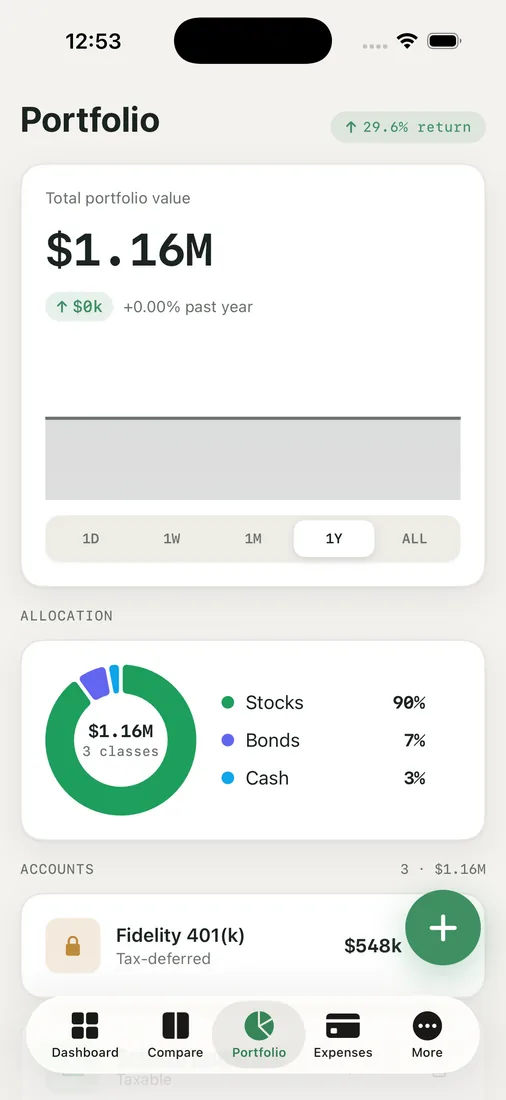
None of this fires at full volume when the underlying data is shaky. If there's a stale price, a missing lot, or a gain you haven't logged for the year, the card mutes its own language — a recommendation to "act" quietly becomes "consider," and it tells you why. A confident-sounding suggestion built on incomplete data is a worse outcome than a hedged one, so the hedge is the point.
Price the sale before you make it
The part I actually wanted after that kitchen-renovation surprise is Trade Scenarios. Instead of eyeballing a sale, you pick the actual lots you're considering, optionally pairing a gain lot with a loss lot, and the engine runs the whole thing through the same year-end machinery that prices everything else in your plan: gain character, the ACA effect, the IRMAA effect, together, in one pass. You see what the trade actually costs before you place it, not after your accountant finds it.

A scenario you like can go straight into your Year-End draft, or you can just save it with a name and come back to it later without touching anything real. Nothing here executes a trade — it's a pricing tool, not a brokerage. It's also US-plans-only for now, and it draws on the same tax engine that runs your Roth conversions and your retirement projections, so a bracket-room number here matches the bracket-room number everywhere else in the app. It's not tax advice; it's what the numbers say your specific lots would do to your specific year, which is the thing I actually needed last October.
Key takeaways
- Holdings now carry real tax lots (shares, cost, date, provenance), and a readiness score shows how complete that data is.
- Portfolio Insights checks bracket room, capital-gains room, ACA cliff distance, IRMAA room, tax-loss candidates, concentration, and cash buffer — all against the current tax year.
- When data quality is weak, recommendations soften from "act" to "consider" and say why, instead of guessing confidently.
- Trade Scenarios price a real sale (gain character, ACA, IRMAA) before you make it, and can feed your Year-End draft or be saved on their own.
Add your lots and check the Portfolio page before your next sale, not after.


