
Why This Result?" — The Evidence Behind Your Number
A new panel shows the deterministic evidence behind your success number — what moves it, whether the models agree, and what actually ran.

We got a plan back at 87 percent once and just sat with it for a minute, not celebrating, just staring. Eighty-seven percent of what, exactly? Eighty-seven percent according to which assumptions, and how far would it move if one of them turned out to be wrong? Mayur wanted to poke at the number until it either held up or fell apart, and there was nowhere in the app to do that poking. The gauge told us the verdict. It did not tell us the evidence.
A number you cannot interrogate is a vibe
That is the plain problem a single success percentage has. It is the output of a real simulation, but it arrives with no seams showing — you cannot tell which of your inputs the number actually depends on, or whether a different but equally reasonable way of running the math would have landed somewhere else. A probability you cannot interrogate is a vibe, not a result, and we wanted the app to show its work.
So under the gauge there is now a "Why this result?" panel, and it does three specific things.
What it actually shows
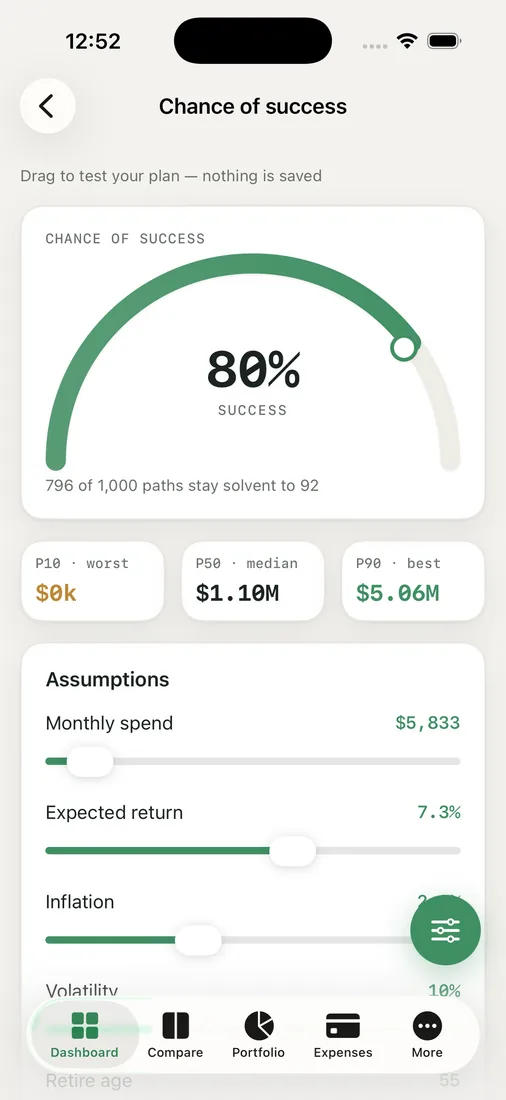
Sensitivities re-run your plan with one assumption changed at a time — spending, retirement age, returns, and similar levers — so the panel can show which of your assumptions actually move your number, and by how much. This is the part that turns "87 percent" into something you can act on: if your number barely moves when you shave a year off retirement age but swings hard when spending drops five percent, that tells you exactly where your plan is fragile.
Robustness runs the same plan through all three return models RetireOdds supports — a random Monte Carlo, a bootstrap of real US market history, and a historical-sequence backtest — and reports whether they agree. A result that only holds up under one model is a result you should not trust yet. When all three land in the same neighborhood, that agreement is itself evidence.
Assumptions disclosure lists what actually ran: household modeling on or off, which healthcare model, whether a Roth conversion schedule is active, bucket-aware taxes, life events. Critically, this list is read from what the engine executed, not from what a settings page claims — so if a toggle you thought was on did not actually apply, this is where you would catch it.

Why the seams matter more than the summary
None of this changes your plan. It changes whether you can trust the number the plan produced. We have caught our own mistakes this way — a life event we thought was included but had actually left disabled, a return assumption that mattered far less than we expected and one that mattered far more. The panel is also available natively in the iOS app, so the same evidence is there whether you are checking your plan at a desk or on a walk.
The instinct to ask "why" after a headline number is a good one. Now the app answers instead of just restating the gauge.
Key takeaways
- Sensitivities show which of your assumptions actually move your success number, and by how much, one lever at a time.
- Robustness runs your plan through all three return models — random, bootstrap, and historical-sequence — and flags whether they agree.
- The assumptions disclosure reflects what the engine actually executed, not what a settings page claims.
- The panel is available on web and natively in the iOS app.
If your plan's headline number has never had to explain itself, check yours and open "Why this result?" to see what is actually holding it up.


