
Claim Social Security at 62, 67, or 70?
The biggest free decision in retirement. Claiming later can grow the check ~77% — we compared all three.

We're in our forties, so Social Security feels far off — but we plan to stop working long before we can claim it, which means the timing of that future check shapes how much we have to lean on the portfolio in between. When we first looked at the numbers, one fact jumped out: claiming at 70 instead of 62 can grow the monthly benefit by roughly 77%. That's not a typo, and it's not a tax dodge. It's the single biggest free decision most people get to make in retirement, and an astonishing number of people make it by default.
So we did what we always do with a big decision — we compared all three ages side by side instead of guessing.
Why the gap is so large
Social Security has an "anchor" age — your full retirement age, around 67 for most people now. Claim before it and your monthly check is permanently reduced. Claim after it, up to 70, and the check permanently grows, by roughly 8% for each year you wait past full retirement age. Stack those adjustments from 62 all the way to 70 and the difference compounds into that ~77% bigger monthly benefit.
Here's the part people miss: this is one of the few guaranteed, inflation-adjusted raises available anywhere. Waiting is, in effect, buying more lifetime annuity income at a very good price. For a healthy person — or the higher earner in a couple, whose benefit a surviving spouse may keep — delaying often pays off handsomely.
But "often" isn't "always," and that's exactly why it deserves a model rather than a rule of thumb.
When claiming early can be the right call
Later isn't automatically better. Claiming at 62 makes sense in several real situations:
- You need the income. If claiming early lets your portfolio survive the gap years without selling into a bad market, the smaller check can protect the bigger pile.
- Health or longevity concerns. The math of "wait for a bigger check" assumes you live long enough to collect it.
- Portfolio relief. Every dollar Social Security pays is a dollar you don't withdraw — which can matter most in the fragile early years of retirement.
The decision isn't really "which check is bigger." It's "which claiming age gives my whole plan the best odds, given how long I might live and how my portfolio behaves in between."
Comparing all three at once
We built three scenarios in Compare Plans — claim at 62, at 67, and at 70 — each running against the same portfolio, spending, and expat settings.
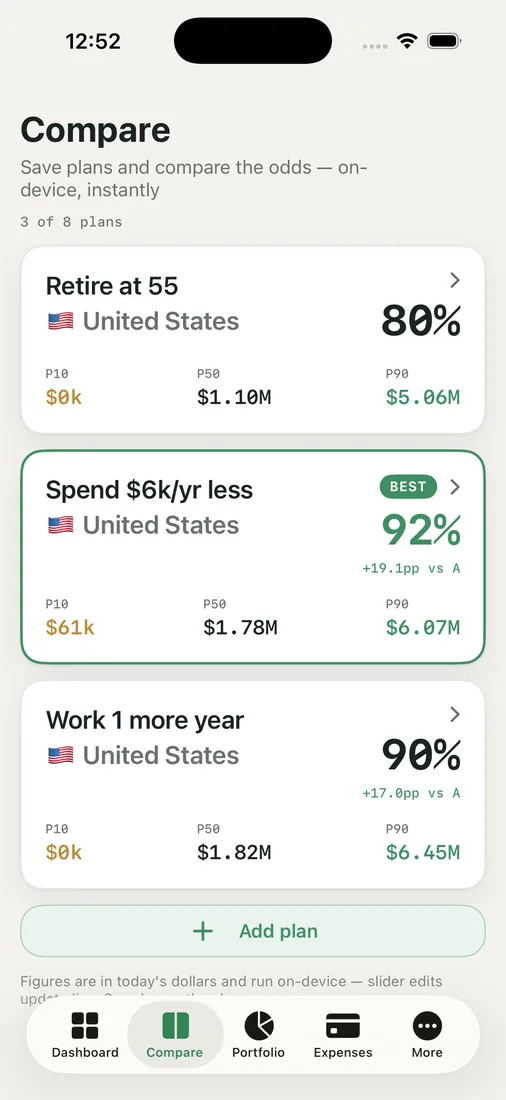
Each came back with a success percentage and a "BEST" badge on the strongest. What's powerful is seeing the interaction: a later claim means leaning harder on the portfolio in the bridge years, which the model accounts for, then a much larger guaranteed check for life afterward. For our plan, waiting toward 70 came out ahead on long-run odds — the bigger lifetime check did more for our survival than the early years of smaller payments would have.
But the gap between 67 and 70 was narrower than the headline 77% suggests, because the early-claim scenarios spend the portfolio less. That nuance is exactly what gets lost when people argue about claiming ages in the abstract.

We also ran the winning scenario through a longer-horizon check to make sure it held up if we live into our nineties — the case where waiting pays off most — and against an earlier-death case where it doesn't. Seeing both ends kept us honest.
Key takeaways
- Claiming at 70 instead of 62 can grow the monthly benefit by roughly 77% — a guaranteed, inflation-adjusted raise that's rare to find anywhere else.
- Later is often better for the higher earner and the long-lived, but claiming early can protect the portfolio in the fragile bridge years or when health is a concern.
- The real question isn't which check is biggest — it's which claiming age gives your whole plan the best odds, accounting for the gap years in between.
- Compare 62, 67, and 70 side by side against the same plan; the gap between them is usually narrower than the headline number implies once portfolio drawdown is included.
Wondering which age wins for you? Run your own odds and compare all three claiming ages against your own plan.


