
Does a Weak Dollar Ruin Your Overseas Plan?
When you earn in dollars but spend in baht or euros, the exchange rate becomes a core retirement risk.

A few months after we landed in Spain, our euro rent didn't change but our dollar cost of it did — by a noticeable amount — because the exchange rate moved. We hadn't spent a cent differently. Our portfolio hadn't dropped. And yet our real cost of living went up, simply because the dollar weakened against the euro. That was the moment the exchange rate stopped being trivia and became one of the central risks in our plan.
If you earn in dollars and spend in another currency, this is your risk too, and most retirement tools ignore it completely.
The mismatch nobody prices in
A standard retirement calculator assumes you earn and spend in the same currency. Withdraw $80,000, spend $80,000, done. But when you live abroad, there's a hidden conversion in the middle: dollars come out of the portfolio, get exchanged into euros or baht, and those are what pay the bills.
When the dollar is strong, that conversion is a tailwind — each dollar buys more local currency, so your overseas life feels cheaper. When the dollar is weak, it's a headwind — the same withdrawal buys less, so you either spend more dollars to keep the same lifestyle or quietly trim your life. Your portfolio can be performing perfectly and your real spending power can still erode.
How big a deal is it, honestly?
Big enough to model, not so big it's hopeless. Currencies move a lot over months but tend to be less wild than stock markets over decades, and they wander rather than trend in one direction forever. A weak-dollar stretch can genuinely strain the early years of a plan — which is the most fragile period, when a bad sequence does the most damage — even if things even out later.
There are natural buffers, too. If some of your future income is local — a pension, part-time work, or a paid-off home in your spending currency — that income isn't exposed to the rate at all. The more of your spending you can match with same-currency resources, the less the exchange rate can hurt you.
Treating it as a real input
The reason we built currency into RetireOdds rather than bolting it on is that you can't reason about an overseas plan without it. The expat tooling carries a dual-currency overlay, so every withdrawal shows in dollars and in what it actually buys locally. And in Compare Plans, we can run the same retirement under different currency assumptions — a persistently weaker dollar in one column, today's rate in another — and watch the odds of success move.
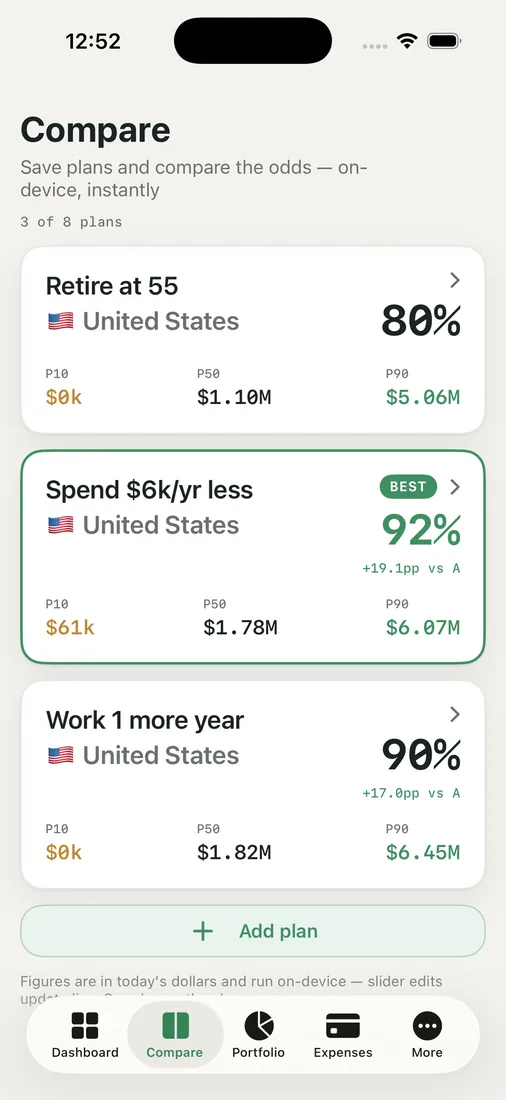
That comparison is the honest answer to the question in the title. A weak dollar doesn't automatically ruin an overseas plan, but it can shave a real chunk off your success rate, and the only way to know your number is to test it instead of hoping. We'd rather find out a plan is fragile to currency at 46 than discover it at 70.

The Monte Carlo engine helps here, too, because currency stress tends to bite worst in the early, sequence-sensitive years — exactly where running a thousand paths shows you the difference between "usually fine" and "fine even in a rough opening decade." As always, this is education, not advice, and cross-border specifics are worth confirming with a professional.
Key takeaways
- If you earn in dollars and spend abroad, the exchange rate is a core retirement risk most calculators ignore.
- A weak dollar can erode your real spending power even when your portfolio is doing fine.
- Local income — a pension, part-time work, an owned home — in your spending currency naturally buffers the risk.
- The fix isn't to predict currencies but to stress-test your plan under a weaker dollar and see how the odds hold up.
Find out how exposed your overseas plan is to the dollar — run your own odds and compare a strong-dollar and weak-dollar future.


