
One Big Trip a Year — Can You Afford It?
Recurring splurges are easy to underestimate. Here's how a yearly trip shows up in a 30-year plan.

Every year we take one proper trip — the kind that doesn't fit in a normal month's budget. Last year it was three weeks through Japan for the four of us, and it came to about $9,000 by the time we counted flights, ryokan stays, trains, and the fact that two teenagers eat like adults. It's the single best money we spend all year, and we have no intention of stopping. The question that nags us isn't whether to take the trip. It's whether we can keep taking it, once a year, for the next thirty years.
Why recurring splurges hide
A $9,000 trip feels like a one-off. You take it, you enjoy it, the credit card clears, and you move on. The mind files it under "special," separate from the regular budget. That filing error is exactly the problem.
Because it isn't a one-off. It's a recurring expense that just happens to arrive once a year instead of once a month. Spread across twelve months, $9,000 a year is $750 a month — a number that, if it were a subscription, you'd absolutely account for. But because it lands in a single lump and feels like a treat, it tends to live outside the plan entirely.
Over thirty years, that "treat" is a quarter of a million dollars of spending in today's terms, before inflation. A line item that large has no business being invisible.
The right way to model it
The fix isn't to feel guilty about the trip. It's to give it a seat at the table as what it actually is: a recurring expense.
In the Expenses view, we enter the annual trip as a recurring line — once a year, at its real size — rather than burying it inside a vague "miscellaneous" cushion or pretending it'll come out of slack. We keep it in today's dollars, so the model inflates it forward on its own, and we can tag the parts in the currencies they're really paid in, since flights tend to be in dollars and the on-the-ground spending lands in whatever country we're visiting.
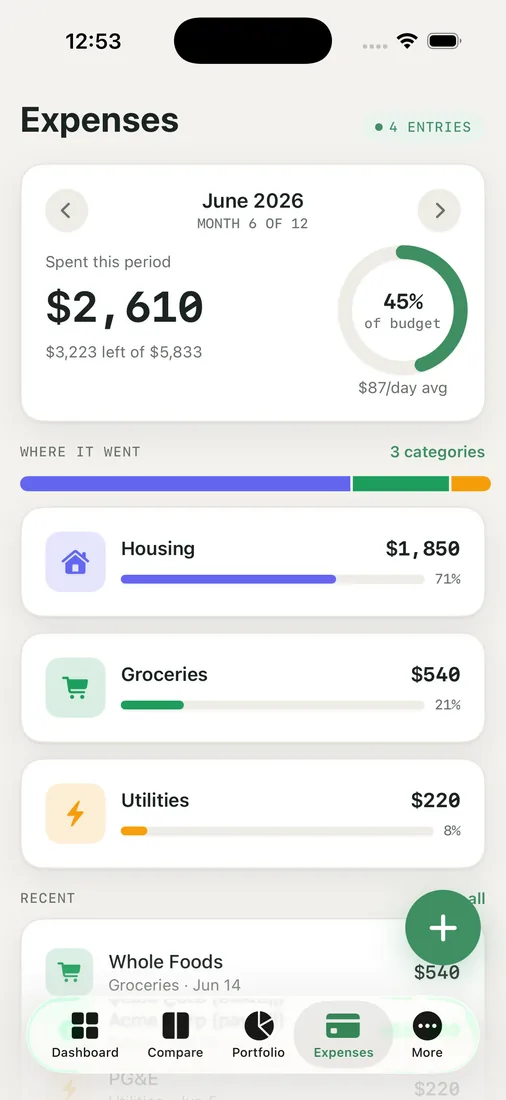
The moment it's in there as an honest recurring item, two good things happen. The plan stops quietly assuming we'll skip the trip in lean years, and the Cash Flow Sankey shows travel as its own visible stream instead of a mystery leak.
What it does to the odds
Here's where it gets useful instead of scary. With the trip modeled properly, we ran the Chance of Success Monte Carlo both ways — with the annual trip in, and with it out — to see what it actually costs us in certainty.
The honest answer for our plan was: a real but survivable amount. Including a $9,000-a-year trip for life pulled our success odds down by several points compared to dropping it entirely. Not catastrophic. Not nothing. Exactly the kind of trade we want to make with open eyes.
And because it's modeled, it becomes a flexible lever rather than a guilty secret. We can see what happens if we take a bigger trip every other year instead of a mid-size one annually, or if we trim it in down markets — the kind of dynamic spending that real retirees actually do. The point isn't to justify or cancel the trip. It's to know its price in odds, so we can decide on purpose.

So, can we afford one big trip a year? For our numbers, yes — at a cost in certainty we're happy to pay. The reassuring part isn't the answer. It's that we got to see the answer before committing thirty years to it.
Key takeaways
- An annual splurge is a recurring expense in disguise — a $9,000 trip is really $750 a month, and over decades it can total a quarter of a million dollars.
- Model it as a recurring line in today's dollars, tagged to the currencies it's paid in, instead of hiding it in a vague cushion.
- Run the odds with the trip in and out to see its true cost in certainty — usually a real but survivable few points.
- Once it's modeled, it becomes a flexible lever you can trim in bad years, not a guilty secret outside the plan.
Got a yearly splurge you can't picture against thirty years? Run your own odds and see what it really costs.


