
Where Does Your Money Actually Go?
Across three countries and multiple currencies, we couldn't see our real spending — so we built a way to.

For a long stretch we genuinely could not answer the most basic question in personal finance: where does our money go? Not because we were careless, but because the answer was scattered across a US credit card in dollars, a DBS account in Singapore dollars, a Spanish account in euros, and the occasional pile of baht left over from years in Thailand. Each statement was honest on its own. Together they told us nothing. We'd "feel" like we were spending about $4,500 a month and be off by a thousand in either direction.
Why expat spending hides from you
A single-country household has it easy here, even if it doesn't feel that way. Their card statement is in one currency, their bank is in one currency, and adding things up is just arithmetic.
Move across borders and the arithmetic breaks. Every account speaks a different currency, exchange rates drift between the day you spend and the day you look, and no single statement sees the whole picture. The result is a kind of fog. You know money is leaving. You can't quite see in what shape.
That fog is dangerous for retirement planning specifically, because the one input every plan depends on most is your real spending. Get it wrong and everything downstream — the savings target, the safe withdrawal, the success odds — is built on sand.
The fix is one common currency to look in
The breakthrough for us was boring and obvious in hindsight: keep spending in the currency you pay in, but convert everything to one common currency when you want to see it.
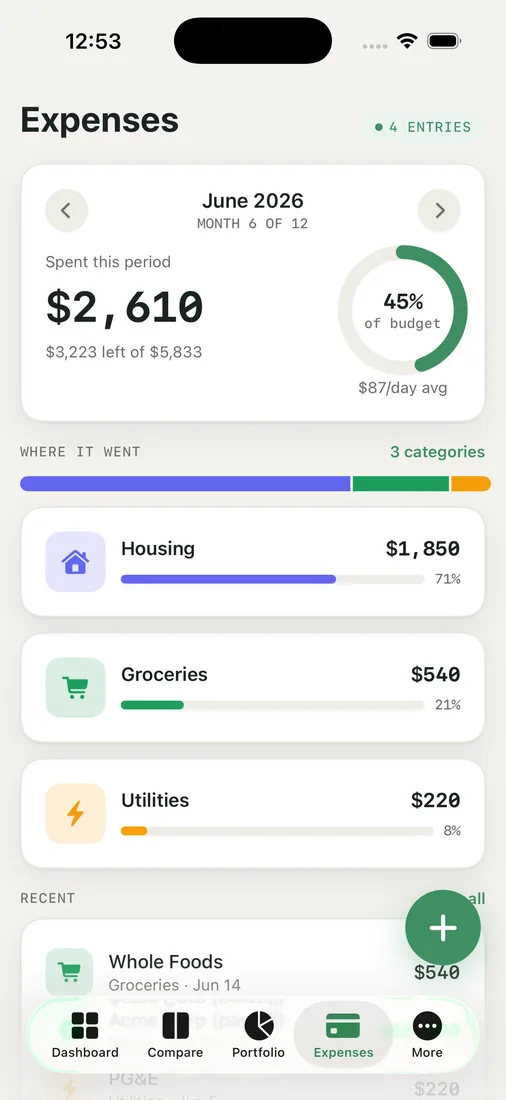
We still pay rent in euros and buy US flights in dollars. Nothing about our actual money changed. But in Expenses, every line is tagged to the currency it's really paid in, and the view rolls it all up into one total we can finally read. The budget ring at the top is the part we didn't know we needed — a simple circle that fills as the month goes on, in our chosen home currency, so the question "are we on track this month?" has an instant answer instead of a four-statement investigation.
From "I think" to "I know"
The first month we did this properly, two things jumped out. Our grocery spend across the euro and SGD accounts combined was higher than either statement alone had suggested — the fog had been hiding it. And a category we'd assumed was small, eating out, was quietly one of our largest, because it was split across three currencies and never showed up as a single number anywhere.
Neither discovery was dramatic. But they were true, and we'd never seen them clearly before. That's the whole value: replacing a vibe with a number.
Why this feeds everything else
Once our real spending was visible, the rest of the tool got honest too. The Cash Flow Sankey could draw an accurate river from income into spending, taxes, and savings, because the spending side was finally measured rather than guessed. And the Chance of Success Monte Carlo was suddenly testing our actual lifestyle against 1,000 market paths, not a hopeful estimate.
That connection is the reason we cared so much about getting expenses right. Every other screen inherits this number. A clear expenses view isn't bookkeeping for its own sake — it's the foundation the whole plan stands on.

These days, the answer to "where does our money go?" takes about ten seconds and a glance at a ring. After years of fog, that clarity still feels a little like a magic trick — but it's just the result of looking at four currencies in one place.
Key takeaways
- For multi-currency households, spending hides across separate accounts and drifting exchange rates, so the most important planning input becomes a guess.
- Keep paying in the currency you spend, but convert everything into one home currency to view it — that's where the fog clears.
- A budget ring turns "are we on track this month?" into an instant glance instead of a multi-statement investigation.
- Accurate expenses feed everything downstream — your cash flow, your safe withdrawal, and your success odds are only as honest as your spending number.
Tired of guessing your real spend? Run your own odds on a number you can finally see.


