
Should You Pay Off the Mortgage Before Retiring?
A paid-off house lowers your spending floor — but the cash had other jobs. We ran it both ways.

We still owe about $180,000 on the place in Spain, at a rate low enough that paying it off has never felt urgent. But as our early-retirement date gets closer, the question keeps resurfacing at the dinner table: should we just clear it before we stop working? On paper we could — we have roughly that much sitting in investments. The pull is emotional and real. A paid-off house feels like freedom. The trouble is that the same $180,000 has another job it's quietly doing, and you can't spend it twice.
The real trade-off
Paying off the mortgage isn't free money appearing. It's moving a chunk of cash from one place (your portfolio) to another (your house). Both moves have consequences, and the honest comparison has to weigh them against each other.
On one side: a paid-off house lowers your spending floor. The mortgage payment disappears from your monthly outflow for the rest of your life. In retirement, a lower fixed floor is genuinely valuable — it means a bad market year requires less from your portfolio, and there's a deep psychological comfort in owing no one anything.
On the other side: that $180,000 was invested, and over a long retirement it might have grown. Pulling it out to clear a low-rate mortgage means giving up that potential growth. You've traded an uncertain return for a certain, modest saving.
There's no universal winner here. It depends on your mortgage rate, your expected returns, your tax situation, and — not least — how much you value sleeping soundly. This is education, not advice. What we can do is stop arguing about it and measure it.
Run it both ways
So that's what we did. We built two versions of our plan and put them next to each other.
Plan A keeps the mortgage and keeps the $180,000 invested. The monthly spending floor is higher, but the portfolio is bigger and working.
Plan B pays the mortgage off at retirement. The portfolio starts $180,000 smaller, but the monthly spending floor drops by the payment for the rest of the plan.
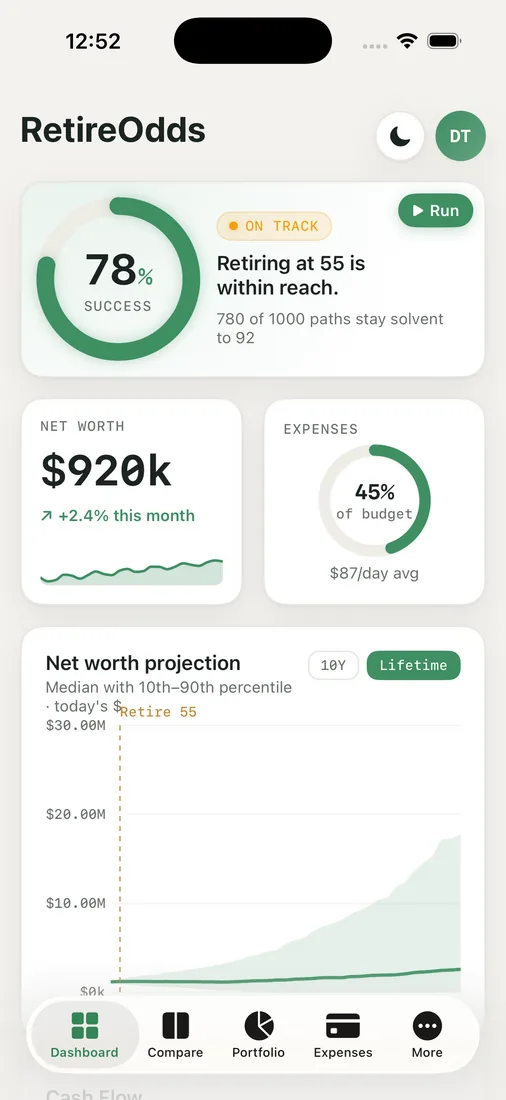
Each version runs through the same Chance of Success Monte Carlo — 1,000 market paths — and lands on its own success percentage. Seeing the two odds side by side did something no debate could: it turned a feeling into a number.
What we actually found
For our specific inputs, the two plans came out remarkably close. The paid-off version had a slightly lower spending floor and a marginally calmer set of bad-luck paths; the invested version had more upside in the good paths. The success percentages were within a couple of points of each other.
That result was clarifying. It meant the choice, for us, isn't really a financial optimization at all — it's a temperament question. Do we want the certain comfort of a paid-off house, or the flexibility and upside of keeping the money invested? Both are defensible. The model just made sure we weren't leaving real money on the table in either direction.
The dashboard view helped here too: with the mortgage gone in Plan B, the net-worth projection and the cash-flow picture both shift visibly, so we could see not just the odds but what each path feels like year to year.

We haven't decided yet — and that's fine. The point was never to find the one right answer. It was to make sure that whichever way we go, we're choosing it with eyes open instead of paying off the house on a gut feeling and hoping it worked out.
Key takeaways
- Paying off the mortgage isn't free — it moves cash from your portfolio to your house, lowering your spending floor but giving up potential investment growth.
- A lower fixed floor is genuinely valuable in retirement: bad years ask less of your portfolio, and owing nothing brings real peace of mind.
- Build it as two plans — keep-and-invest vs. pay-it-off — and compare their success odds side by side instead of debating in the abstract.
- When the two odds land close together, the decision is about temperament, not math — and the model's job was to confirm there's no big penalty either way.
Wondering which way the numbers lean for you? Run your own odds both ways and compare.


