
Roth Conversions: The 10-Year Window Nobody Uses
The years between retiring and RMDs are a tax gift. Here's how to build the ladder that uses them.

When we mapped out our retirement income year by year, one stretch jumped off the screen: the gap between the day we stop working and the day required distributions begin. For us that's roughly a decade — no salary, Social Security not yet claimed, the kids' college bills winding down. On paper it looks like a lean period. In tax terms, it's the most valuable window we'll ever have, and almost nobody plans for it.
Why the gap is a gift
Tax brackets reset every year. If your taxable income in a given year is low, the lowest brackets sit there empty — and once the year ends, that low-rate space is gone forever. You can't carry it forward.
In our peak earning years, those low brackets were already full of salary by January. In the gap years, they'll be wide open. That means we can pull money out of our traditional 401(k) and IRA, pay tax on it at very low rates, and move it somewhere it will never be taxed again. The mechanism is a Roth conversion: you transfer money from a traditional account to a Roth, report it as income that year, and pay the tax now instead of later.
Do this on purpose, a slice at a time, year after year, and you've built a Roth conversion ladder.
The two clocks you're racing
The window closes for two reasons, and both matter.
First, required distributions. Once RMDs start, the IRS forces money out of your traditional accounts on its own schedule, stacked on top of Social Security. Every dollar you convert during the gap is a dollar that won't be forced out at a higher rate later.
Second, Social Security and Medicare. Once you claim benefits and approach 65, new income can make more of your Social Security taxable and can trip IRMAA surcharges on Medicare premiums. Conversions are cleanest before those tripwires are armed.
Sizing each rung
This is where a ladder beats a guess. Convert too little and you waste cheap bracket space. Convert too much and you spill into a higher rate, or push yourself over a healthcare-subsidy cliff. The right number is different every year because your other income changes.
In RetireOdds, the Roth conversion tool builds the ladder year by year. It looks at how much low-bracket room each future year has, suggests a conversion that fills it without spilling over, and shows the trade-off in plain numbers: more tax now, far less tax — and smaller forced distributions — later.
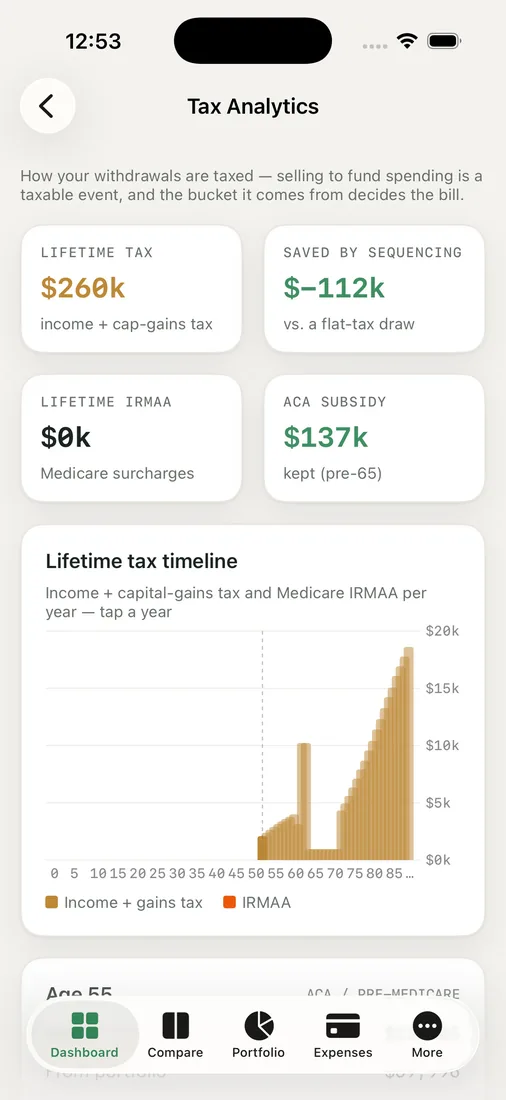
What made it click for us was seeing the two futures side by side. In the do-nothing version, our traditional balance balloons and the RMD bars in our seventies are alarming. In the ladder version, we pay a modest amount of tax in the quiet years and the later tax mountain mostly melts away. Same money, very different lifetime bill.

The catch for early retirees
There's an honest complication for those of us retiring young. Converted money has its own five-year clock before you can touch the converted amount penalty-free, and you need cash to pay the conversion tax — ideally from a taxable account, not from the conversion itself. We also have to weigh the ACA health-insurance subsidy: a conversion raises the income that subsidy is based on, so the cheapest bracket year for taxes might be an expensive year for premiums. There's no universal answer here, which is exactly why we model it and then confirm the plan with a professional rather than eyeballing it.
Key takeaways
- The years between retiring and RMDs are usually your lowest-income years and your best chance to move money out of traditional accounts cheaply.
- A Roth conversion ladder fills the low brackets each year on purpose, so less is forced out later at higher rates.
- Convert too much and you can spill into a higher bracket or over an ACA subsidy cliff — the right amount changes every year.
- You need outside cash to pay the conversion tax, and converted dollars carry their own five-year clock.
Your window may be wider than you think, but it won't wait — run your own odds and see how much low-bracket space you have this decade.


