
RSUs Vesting: How Much Is 'Enough' to Walk?
Equity comp turns into your number one paycheck — and one day, your exit. How we find the 'enough' line.

For a few years, Mayur's RSUs quietly became the biggest line in our income. The salary paid the bills; the vesting was what actually moved the net worth. And once equity becomes your number one paycheck, a strange thing happens — every vesting date starts to feel like it might be the one that lets you walk. The hard part isn't earning more. It's knowing where the line is. How much is enough?
We learned that "enough" is not a vibe you arrive at one good quarter. It's a specific number you can test against a 40-year horizon.
"Enough" is a finish line, not a feeling
The trap with equity comp is that it never feels like enough. Each vest makes the number bigger, the lifestyle creeps up to match, and the finish line politely steps back the same distance you stepped toward it. People who could have walked years ago keep grinding because they never defined the line — so they can never cross it.
The fix is to flip the question. Instead of "how much could I earn if I stay?" ask "what's the smallest portfolio that funds our life with comfortable odds?" That number is your enough. Everything past it is optional — a bigger cushion, a nicer life, or just more of the same. But you can only treat it as optional once you know where it is.
Two complications make this harder than it sounds for equity-heavy households:
- Concentration. Vested RSUs that you don't sell leave you over-exposed to one company. Your job and your savings ride on the same horse.
- Taxes. RSUs are taxed as ordinary income when they vest, and selling later adds capital gains. The number that hits your account is smaller than the number on the grant.
Finding our line
We built a few scenarios in Compare Plans, each anchored to a different "walk" point:
- Walk now — stop at the current portfolio, sell down the concentrated stock, live on what's there.
- One more vest — work through the next big cliff, then leave.
- Two more years — let a couple more grant cycles land before pulling the plug.
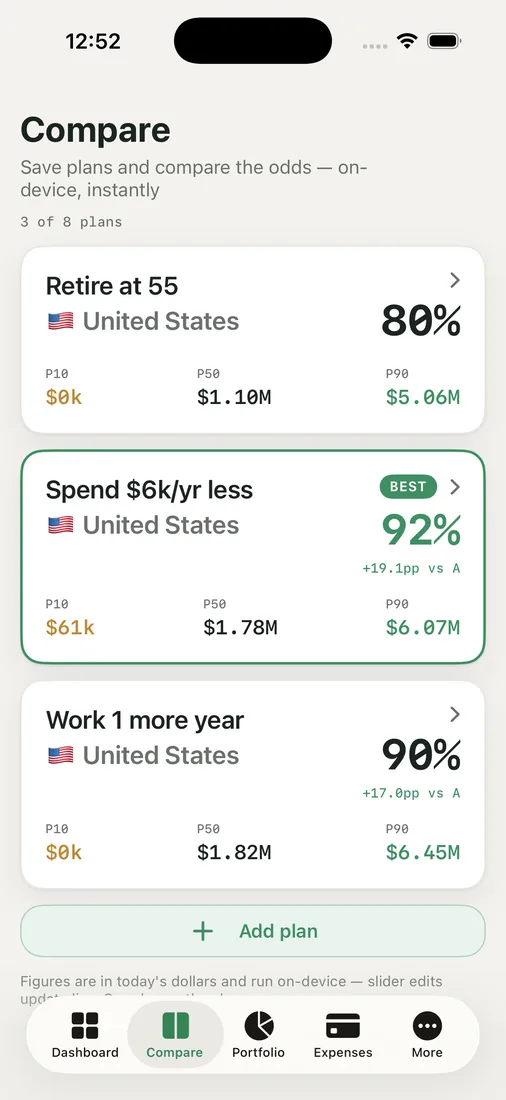
Each came back with a success percentage and a "BEST" badge. What we were really hunting for was the first scenario that cleared a margin we could sleep on. That scenario is "enough." Anything earlier is a gamble; anything later is overtime we're choosing to work, not have to.
For us, "one more vest" was the line — it crossed into comfortable territory, and the second extra year added safety we liked but didn't strictly need.
We checked the after-tax reality
Before trusting any of it, we ran the concentrated-stock sale through Tax Analytics to see the real after-tax proceeds and whether staging the sales across tax years beat selling all at once. The "saved by sequencing" number was bigger than we expected — enough to matter to the timeline.
Then we took the winning plan into Chance of Success and watched the unlucky-market path. A plan that only survives if your company's stock keeps rising isn't freedom — it's the same bet you were already making, just with more of your money on the table.

Once we could see our enough line, every vest after it stopped feeling like a leash and started feeling like a choice. That shift — from "I can't leave yet" to "I'm choosing to stay" — was worth more than the grants.
Key takeaways
- "Enough" isn't a feeling you reach in a good quarter — it's the smallest portfolio that funds your life with comfortable odds, and equity comp will keep moving the line if you don't pin it down.
- Vested RSUs concentrate your net worth in one stock and are taxed as income; the spendable number is smaller and riskier than the headline.
- Build a few "walk" scenarios and find the first one that clears a margin you can sleep on — that's your line; everything after is optional overtime.
- Check the after-tax proceeds and the unlucky-market path before you trust the line, so you're not just betting on your company's stock to keep climbing.
Wondering if you're already past your line? Run your own odds and find out where 'enough' actually is.


