
The Widow's Tax Trap
When one spouse passes, the survivor often jumps to single brackets on similar income. Plan for it now.

This is the post we almost didn't write, because the scenario behind it is the one no couple wants to model. But avoiding it is exactly how families get hurt. When we built our long-range plan, we forced ourselves to run a version where one of us is gone — Mayur at 46, Mona at 43, we hope it's decades away — and the tax result was sharper than the grief math we'd braced for. On nearly the same income, the surviving spouse owed noticeably more to the IRS. Nothing about the spending had changed. Only the filing status had.
Why losing a spouse raises the tax rate
The US tax system gives married couples roughly double the room of a single person. The standard deduction is about twice as large, and the brackets are about twice as wide. Two people, two sets of allowances.
When one spouse dies, that doubling collapses. After a short grace period, the survivor files as single — half the standard deduction, brackets that are half as wide. But the income often doesn't fall by half. The portfolio is still there, the required distributions still come, and Social Security drops by only the smaller of the two benefits, not by half.
The result is that the survivor can land in a higher bracket on similar income, watch more of their Social Security become taxable, and even trip IRMAA surcharges on Medicare — all in the year they can least handle paperwork.
A concrete picture
Suppose a couple has $90,000 of taxable income and sits comfortably in a low bracket. If one spouse passes, the survivor might still have, say, $70,000 of income — but now squeezed through single brackets and a single standard deduction. That income that was barely taxed before can now spill into the next rate up, and the survivor's effective rate climbs even though they're living on less.
For a couple with a large traditional balance, this compounds. The forced distributions that were manageable filed jointly become punishing filed single, year after year, for the rest of the survivor's life.
Planning for it while there are two of you
The good news is that the very thing that makes a couple's brackets generous is the thing you can use while you still have it. The wide married brackets are a resource with an expiration date you can't predict.
That's an argument for doing tax-smart work now, together — drawing down traditional balances at today's low married rates through Roth conversions, harvesting gains in the years there's room, and not leaving an enormous tax-deferred balance for one person to unwind alone under single brackets. Money moved to Roth is especially valuable here, because it generates no taxable income for the survivor at all.
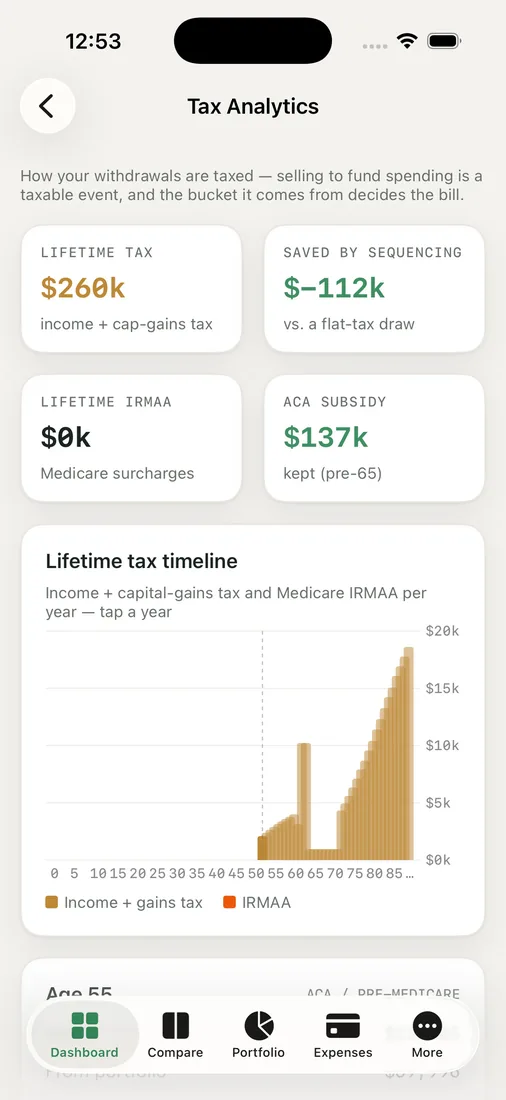
In RetireOdds, we model both paths in Tax Analytics — the joint plan and the survivor scenario — so the size of the jump is a number we can see rather than a surprise. Watching the survivor's bracket climb is uncomfortable, but it's what convinced us to use our married years deliberately.

This is an area where the human and the numbers both matter, and it's genuinely education rather than advice. Beneficiary designations, the timing of conversions, state rules, and estate considerations all interact, so we sketch the plan in the model and then sit down with a professional to make it real.
Key takeaways
- When one spouse dies, the survivor usually files single — about half the standard deduction and half-width brackets — while income falls much less.
- The result is a higher effective rate on similar money, plus more taxable Social Security and possible IRMAA surcharges.
- A large traditional balance hits hardest, because required distributions get squeezed through single brackets for the rest of the survivor's life.
- The wide married brackets are a resource with an unknown expiration date — using them now for Roth conversions and gain harvesting protects the survivor later.
Model the scenario you'd rather not think about — run your own odds and see how the survivor's bracket changes.


