
Two Kids, Four Years Apart: The Funding Gap
Overlapping college years create a cash-flow crunch. Here's how we're smoothing ours.

Our kids are three years apart on paper, but with the way their school years line up, there's a stretch where both will be in college at the same time. We mapped it out one weekend and got a small shock: for roughly two academic years, we'll be writing two tuition checks at once. If each runs around $40,000 a year all-in, that's an $80,000-a-year spike landing right in the window when we'd hoped to be easing off work.
A single kid's college bill is a known quantity you can plan around. Two at once is a cash-flow spike — a short, brutal hill in the middle of the road — and it's the part most people don't see coming until it arrives.
Why the overlap hurts more than the total
The total cost of educating two kids isn't the scary part. You can spread that over many years. The scary part is the concentration. When the bills overlap, your spending doesn't just rise — it doubles for a defined window, and it does it at the exact moment your portfolio is most vulnerable.
That vulnerability has a name: sequence-of-returns risk. Pulling a large chunk out during a down market early in retirement does lasting damage, because the dollars you sell at the bottom never get to recover. An overlapping-college spike is a sequence-risk magnet. If it coincides with the year you stop working and a rough market, three bad things stack on top of each other.
For us the geography adds a twist. We spend in euros, our 529s are in dollars, and a bad exchange-rate year during the overlap could quietly inflate the bill on top of everything else. So smoothing the spike isn't optional for us — it's the whole game.
Seeing the spike before it hits
The first thing we did was make the hill visible. On the dashboard, we laid our projected cash flow against the year-by-year college costs so the overlap window showed up as an obvious double-height bar instead of a vague worry.
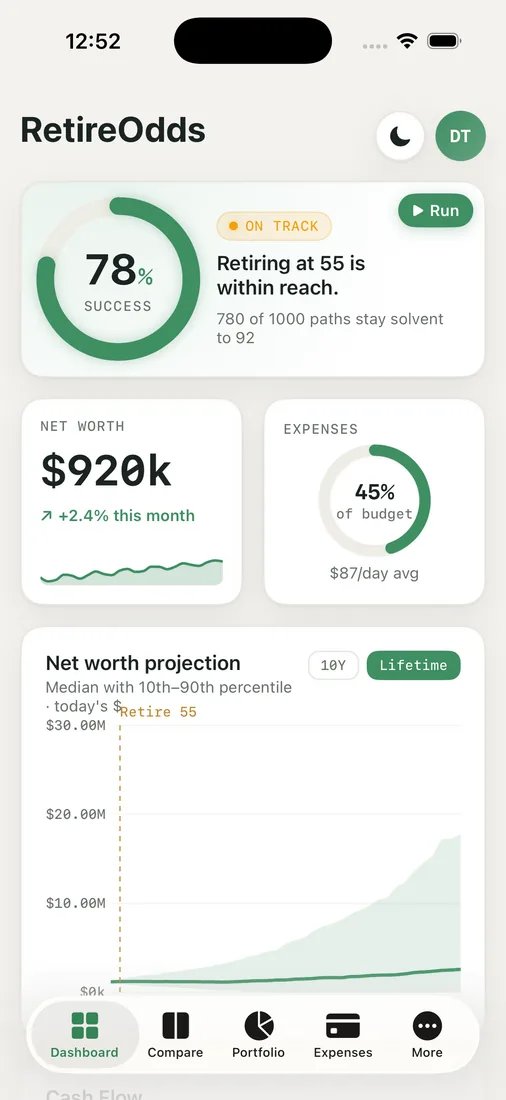
Seeing it drawn out changed the conversation. The spike wasn't abstract anymore — it was two specific years with a specific shortfall. And once you can see exactly where the hill is, you can plan the approach to it.
How we're smoothing ours
We're using a few levers, none of them dramatic:
- Front-load a buffer. Rather than fund both 529s evenly, we're building a slightly larger cash and bond cushion timed to the overlap, so we don't have to sell stocks into a possible downturn during those two years.
- Stagger the spending, not just the saving. A cheaper first year or two for the older one — community college credits, a public option, or a year abroad — can shrink the height of the double-tuition window.
- Protect the retirement date around the hill. We keep one foot in part-time or consulting income through the overlap years, so the portfolio isn't carrying the full spike alone right when it's most fragile.

The combination flattens the worst of it. In our model, smoothing the overlap with a timed buffer and a little flexible income preserved most of our long-run odds, where hitting the spike unprepared in a bad year did real, lasting harm.
We treat those two years as a named risk now, not a surprise. We know roughly when the hill is, how tall it is, and what we'll lean on to get over it without selling at the bottom.
Key takeaways
- The danger of two kids in college isn't the total cost — it's the concentrated spike when bills overlap, often landing near your retirement date.
- That spike is a sequence-of-returns magnet: a big withdrawal in a down market early on does damage that doesn't recover.
- Make the overlap visible by plotting cash flow against year-by-year college costs, so you can see the hill before you're climbing it.
- Smooth it with a timed cash-and-bond buffer, staggered or cheaper first years, and a little flexible income — not by hoping the market cooperates.
Got an overlap window coming? Run your own odds and see the spike before it sees you.


