
Will You Outlive Your Money?
The question behind every retirement plan, answered as a straight verdict instead of a vibe.

For years, "will we outlive our money?" lived in our house as a feeling rather than a fact. It would surface at the worst times — a market dip, a tuition estimate, a quiet Sunday — and we'd reassure each other with vibes. "We're probably fine." Probably. For a couple at 46 and 43 with two kids and a plan to stop working early, "probably" turned out to be the most expensive word in our vocabulary, because it let us avoid actually checking.
The whole point of RetireOdds was to replace that feeling with a verdict.
The question every plan is secretly asking
Strip away the jargon and every retirement plan is trying to answer one thing: will the money last as long as you do? It sounds simple, but two unknowns make it genuinely hard.
The first is how long you'll live, which nobody knows and most people underestimate. The second is what markets will do, which nobody knows either. Plan for too short a life or too smooth a market, and you can run out at exactly the moment you have the fewest options.
That's why we stopped looking for a single number and started looking for a probability. "Will you outlive your money" has a much better answer when you phrase it as: across a thousand possible futures, in how many does the money run out before you do?
A verdict, not a vibe
The dashboard is where we get the straight answer. Instead of a wall of spreadsheets, it leads with a plain-language read on whether our plan holds, backed by the same 1,000-path simulation that powers everything else.
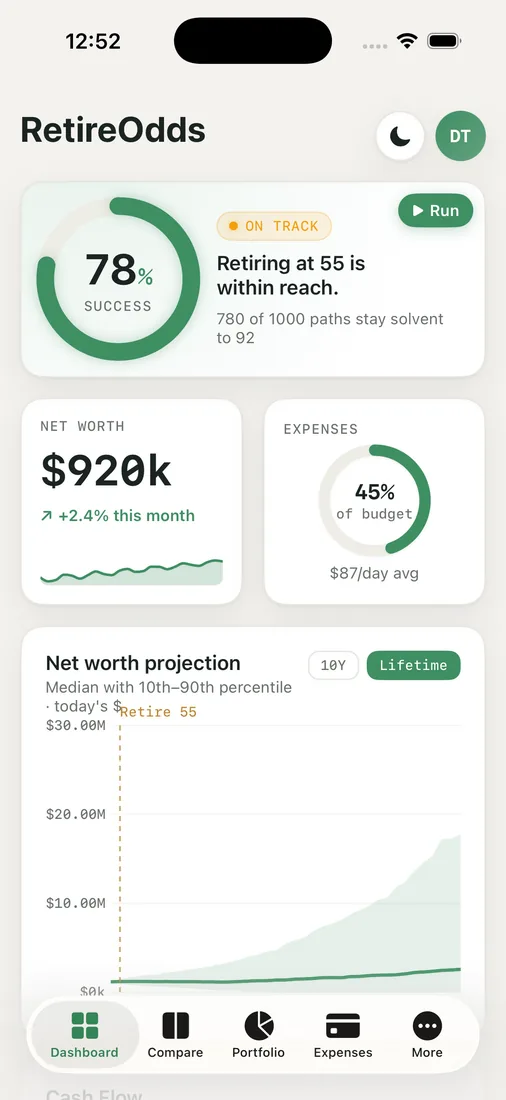
What we appreciated is that it doesn't bury the lede. The headline is the verdict. The supporting detail — the percentile bands, the projection in today's dollars — is right there when we want to dig, but the first thing we see is the answer to the question we actually came with.
Why the worst case matters most
When we read the result, we deliberately stare at the low end. The median path is pleasant, but it's not the one that scares us. The P10 path — the rough worst case — is. If the plan survives there, the better futures take care of themselves. If it doesn't, no amount of average-case optimism saves us. Outliving your money is, almost by definition, a worst-case event, so that's where the honest planning happens.
Turning the verdict into action
A verdict is only useful if you can change it. When ours came back thinner than we liked, we didn't panic — we adjusted. Trimming spending a little, nudging the retirement date, revisiting how aggressively we wanted to spend in the early years; each move shifted the answer, and the dashboard updated so we could see whether the shift was meaningful or just noise.

We also keep coming back to it. The verdict isn't a one-time stamp — markets move, our spending drifts across currencies, the kids get closer to college. Checking in turns a scary, abstract fear into a number we can watch and steer, which is a far better feeling than "probably fine."
Key takeaways
- "Will I outlive my money" is best answered as a probability across many futures, not a single projection.
- A clear verdict beats a vague reassurance — lead with the answer, then dig into the detail.
- Plan against the worst-case (P10) path, because running out of money is itself a worst-case event.
- Re-check over time; the verdict changes as your spending, markets, and life change.
Trade "probably fine" for an actual answer — run your own odds and see the verdict.


